

Hearing aids have a pricing problem. Not because they're overpriced, but because nobody gives you a straight answer upfront.
You search online, you see ranges from $199 to $7,000, and suddenly you don't know if you need to take out a second mortgage or if you can pick something up at CVS. It's genuinely confusing, and that confusion causes a lot of people to delay getting help they actually need.
So let's cut through it.
Most hearing aids in Rochester range from $1,500 to $6,500 per pair, depending on technology level and what kind of professional support is built into the price. That wide range exists for real reasons - and understanding those reasons is what actually helps you make a smart decision.
Here's exactly what affects cost, what you should expect in our area, and how to figure out what makes sense for your situation.
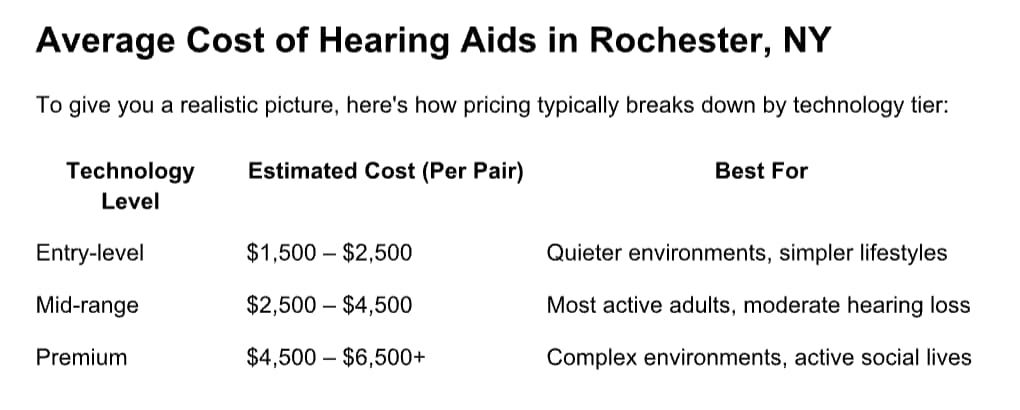
A few things to keep in mind about these numbers:
This isn't just a device price. When you work with a licensed audiologist or hearing aid specialist, the cost typically includes fitting, programming, follow-up adjustments, and ongoing care - not just hardware. That's a meaningful distinction we'll come back to.
Financing is available. Many providers, including our office, offer monthly payment options that bring even premium devices into a manageable range. If sticker shock is the reason you haven't moved forward, it's worth asking about financing before you rule anything out.
There's no single "right" price. The goal is matching the right technology to your specific hearing loss, lifestyle, and budget - not upselling you to the most expensive option.
If you want a clear idea of pricing based on your hearing needs, the best next step is a quick consultation. We'll tell you exactly what makes sense for you without any pressure.
What Affects the Cost of Hearing Aids?
Technology Level
This is the biggest driver of price, and it's about more than just sound quality. Higher-tier hearing aids include features like:
- Background noise reduction - especially useful in restaurants, crowded spaces, or meetings
- Directional microphone systems - so you can focus on the person in front of you
- Bluetooth connectivity - stream audio directly from phones, TVs, and computers
- Rechargeable batteries - no fumbling with tiny batteries every few days
- AI-powered sound processing - some newer devices actually adapt in real-time based on your environment
Entry-level devices do the job in straightforward situations. If your main concern is hearing conversation at home or one-on-one, they can work well. If you're still working, attending events, or spend time in noisier environments, mid-range or premium technology tends to pay off in daily quality of life.
Style and Size
Hearing aids come in several physical styles, and each affects both price and practicality:
- Behind-the-Ear (BTE) - the most common, most powerful, and typically the most affordable style
- Receiver-in-Canal (RIC/RITE) - slim and discreet, the most popular option today across all technology tiers
- In-the-Ear (ITE) - custom-molded to your ear, more visible but very easy to handle
- In-the-Canal (ITC) and Completely-in-Canal (CIC) - progressively smaller and less visible
- Invisible-in-Canal (IIC) - sits entirely inside the ear canal, nearly undetectable
Smaller devices often cost more because of the miniaturization involved. They also tend to have shorter battery life and fewer features. For many people, the visibility of a hearing aid is a top concern - and it's worth knowing that today's RIC devices are already quite small and subtle.
Included Services
This is the cost factor most people overlook, and it's arguably the most important one.
A hearing aid on its own is just hardware. What makes it work for you is how it's programmed, fitted, and adjusted over time. A professional fitting includes:
- A comprehensive hearing evaluation
- Real-ear measurement (verifying the device is actually delivering the right amplification for your ear)
- Initial programming tailored to your audiogram
- Follow-up visits to fine-tune based on your real-world experience
- Troubleshooting and maintenance
When you buy online or from a big-box retailer, you're often paying for the device alone. When you work with a local hearing specialist, that service package is typically bundled in. Over the course of a few years, that support often matters more than which device you bought.
Warranty and Support
Most professional-grade hearing aids come with a manufacturer warranty of 2–3 years, covering repairs and often one-time loss or damage replacement. Extended warranty options are usually available.
If something goes wrong two years in (and with something worn 16 hours a day, things occasionally do), having that coverage, plus a local provider you can call, makes a real difference. It's part of why the total cost of working with a specialist tends to be more defensible than it looks upfront.
Are Hearing Aids Covered by Insurance?
This is one of the most common questions we get, and the honest answer is: it depends.
Private insurance: Coverage varies significantly by plan. Some plans offer a hearing aid benefit (often $500–$1,500 per ear every 1–3 years), while others offer nothing. It's worth calling your insurance company directly and asking specifically about hearing aid benefits. Don't assume based on the general plan summary.
Medicare (Original): Standard Medicare Part B does not cover hearing aids. It may cover a diagnostic hearing exam if ordered by a physician, but the devices themselves are not included. This catches a lot of people off guard.
Medicare Advantage: Some Medicare Advantage plans do include hearing aid benefits. Coverage amounts and approved providers vary by plan, so check your specific plan documents.
Medicaid: Depending on the state and plan, Medicaid may provide some coverage, particularly for lower-income adults.
Veterans Benefits: Veterans with service-connected hearing loss may receive hearing aids through the VA at no cost. This is an underutilized benefit worth looking into.
Financing options: For gaps that insurance doesn't cover, many hearing care providers offer third-party financing through programs like CareCredit, which allows you to spread payments over 12–24 months, sometimes interest-free.
We're happy to help you navigate your insurance situation as it's a routine part of what we do.
Why Prices Can Vary So Much
You've probably seen hearing aids advertised for $200 or less. So why are we talking about thousands of dollars?
A few reasons:
Over-the-counter (OTC) devices are a different category. Since 2022, the FDA has allowed OTC hearing aids for adults with mild to moderate hearing loss, and they're available at retailers like Best Buy and Walgreens. For the right person, in the right situation, they can provide some benefit. But they're self-fitted, not professionally programmed, and not designed to address more significant hearing loss. They're also not covered by warranty through a hearing care provider.
Cheap amplifiers aren't hearing aids. Personal sound amplification products (PSAPs) make everything louder — they don't treat hearing loss. Wearing one is a bit like trying to fix blurry vision by turning up the brightness on your phone. It doesn't address what's actually happening.
The total cost of a poor decision is high. Studies have linked untreated hearing loss to increased risk of cognitive decline, social isolation, and depression. Getting the wrong device - or no device - isn't neutral. The ongoing cost of not hearing well shows up in quality of life, relationships, and in some cases, health outcomes.
The better question isn't "how do I spend the least?", it's "what's actually going to help me hear better?"
What You Get When You Work With a Local Specialist
There's a meaningful difference between buying a hearing aid and getting properly fitted for one.
At Morabito Hearing Aid Center, every patient goes through a thorough evaluation before we ever talk about devices. We want to understand your hearing loss, your lifestyle, your communication challenges, and your goals - because those factors drive the recommendation, not the other way around.
What that looks like in practice:
- Custom fitting based on your audiogram and ear anatomy
- Real-ear verification to confirm the device is working as intended - not just assumed
- Ongoing adjustments as your brain adapts to hearing aids (this takes time and professional support)
- A local office you can call when something feels off or you have questions
- Long-term relationship with a provider who knows your history
This is fundamentally different from what you get from an online retailer or a one-time big-box fitting. Hearing aids aren't a product you wear once and forget. They require tuning, especially in the first few months.
How to Know What's Right for You
Here's the honest answer: there's no way to know what hearing aid is right for you without a hearing evaluation first.
Your audiogram (the result of a hearing test) tells us the type and degree of your hearing loss. That shapes everything: which technology tier you actually need, which styles are appropriate, and what features will make a real difference in your daily life versus which ones you'll never use.
We've seen patients come in convinced they needed the most expensive option, and leave with something in the mid-range that fit their lifestyle perfectly. We've also seen the opposite. The point is: it shouldn't be a guess.
Recommendations based on actual data also hold up better over time. When we know what we're dealing with, we can make a recommendation you'll feel confident about, and that confidence tends to make a real difference in whether people actually wear their hearing aids consistently.
Schedule a Consultation to Get Exact Pricing
If you've made it this far, you're probably ready to stop researching and start getting real answers.
Here's what a consultation with Morabito Hearing Aid Center actually looks like: we'll do a comprehensive hearing evaluation, go over your results with you in plain terms, and walk through what options make sense based on your hearing loss and lifestyle. No pressure, no jargon, no one trying to steer you toward the most expensive device on the shelf.
You'll leave with a clear picture of what's going on with your hearing, what your realistic options are, and what it would cost, including any insurance benefits that apply to your situation.
Serving Rochester and the surrounding area, we've been helping patients navigate hearing loss for years. If you have questions before you come in, call us. If you're ready to schedule, we make that part easy too.
Schedule Your Hearing Consultation →
Morabito Hearing Aid Center serves Rochester, NY and surrounding communities. We specialize in hearing evaluations, hearing aid fittings, and long-term hearing care for adults of all ages.